Greetings
Nurturing People of Rich Heart Through Kimono
Creating a spiritually rich Japan through traditional Japanese dress
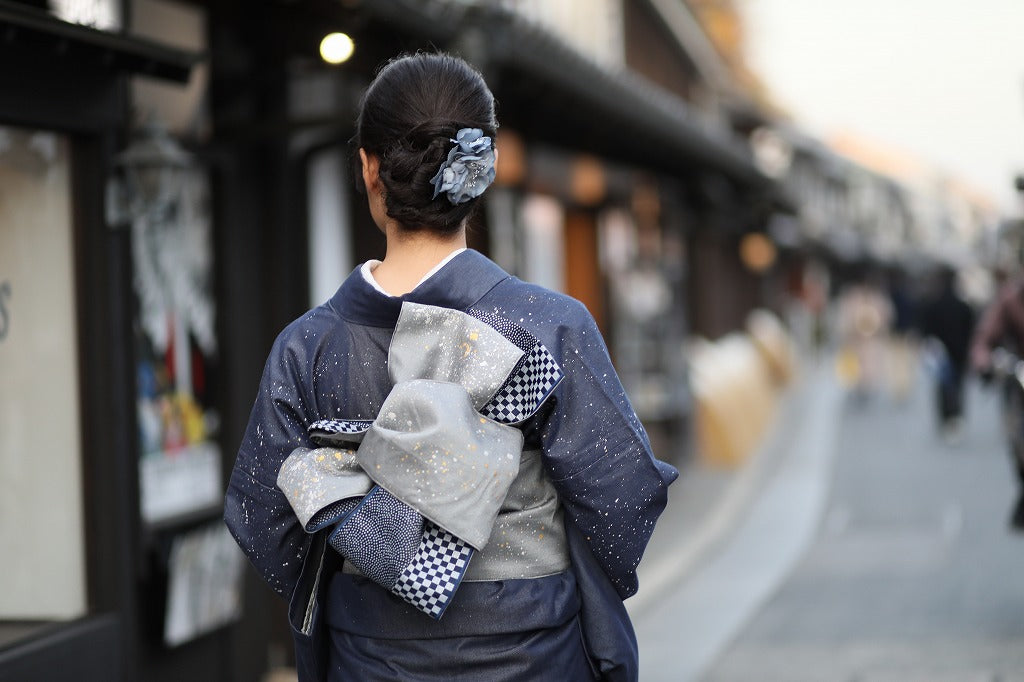
Wearing Japanese dress corrects the posture of the body and brings about careful,
unhurried movement.
Careful movement, in turn, settles and calms the heart.
From there begins a daily life in which one treats both others and oneself with care.
Using denim — a specialty product of Okayama loved around the world —to create wasou (Japanese-style dress),I hope to support a way of living in which "people, things, and matters are all treated with care and attention," and to help nurture a spirit of mutual respect between one another.

I was born in Kobe City.
In the 1995 Great Hanshin-Awaji Earthquake, my family home was damaged in the disaster.
Fortunately, my family and neighbors were all safe.
But because we ended up in different evacuation shelters, and because of subsequent moves, by the time I looked up, the community I had known so well had disappeared.
The people who had always watched over me as I grew up were people I could no longer see.
That was, for me, a profound experience of feeling that I had "lost my hometown."

One day, I learned that Kojima was known as a "town of textiles."
Kojima, a town facing the Seto Inland Sea,began cultivating cotton roughly 400 years ago;
through the Kitamae-bune shipping routes and other means of transporting goods,
Kojima's textiles spread to regions across Japan,forming the basis of the textile industry there today.
Over its long history,this textile industry, as it developed,connected people to one another
— and connected people to their town as well.
"I see," I thought. "As long as there is industry, the town survives."

As for myself, because I had already been living in Okayama for about ten months before the Great Hanshin-Awaji Earthquake struck, I was spared the violence of that great tremor, and was able instead to offer support from a distance afterward — delivering relief supplies, serving as a contact for confirming people's safety.
"I was protected by Okayama." That is how I came to feel.

It may be a very personal conviction, but I have come to want to repay that debt to Okayama.
I never want anyone else to lose their "hometown" the way I did.
Supporting industry, I believe, is directly tied to preserving a town.
Okayama has long been home to a thriving textile industry.
Among its products, denim is especially well known.
It is also home to the nation's top share of tatami-beri (tatami edging), and to sanada-himo, the narrowest of flat-woven cords.

Precisely because Okayama brings together such a rich and varied array of textile industries found nowhere else, I want to create a world of "elegant, stylish denim wasou, born in Okayama" — one of outstanding quality and dignity — so that, a hundred years from now, people will say, "Okayama — that's the place known for silk-denim kimono and Kojima obi."
In doing so, I hope to preserve the town and carry its culture forward.
I believe, without any doubt, that within that vision lies a future in which an industry with deep roots in history nurtures wasou, and wasou in turn nurtures people of rich and abundant heart.
