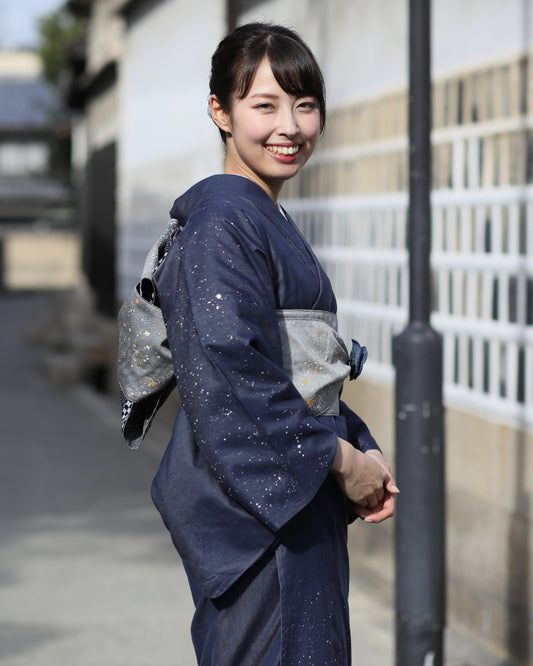
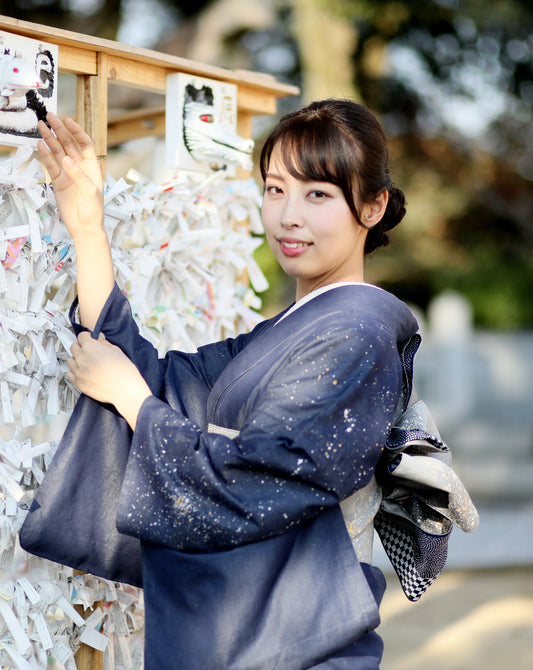
Kimono and obi are covered in all kinds of patterns, and the meaning behind each one runs surprisingly deep — genuinely fascinating, once you look into it.
"Seigaiha" (Waves in a blue ocean)

Seigaiha is, quite literally, a monyou of continuous, overlapping arcs resembling ocean waves.
It's said to have traveled to Japan from ancient Persia by way of China.
One theory traces the name back to its use in the costume for Seigaiha, a piece of gagaku (traditional Japanese court music and dance) performed at shrines and the imperial court to mark celebratory occasions.
Given the name "Seigaiha," meaning "blue ocean" and "waves,"
I believe many people associate it with "summer."
But because the waves are stylized rather than literal, this is actually a pattern you can enjoy year-round, with no need to tie it to any particular season.
The Meaning Behind Seigaiha
Waves roll in and pull back, over and over, in an endless cycle.
Because that motion never ends, seigaiha carries a wish for things to continue forever — for what, exactly? Things like long life, happiness, and peace.
There's one more essential piece to the meaning: these are calm waves. Seigaiha is a monyou that expresses a wish for gentle, lasting happiness — carried forward without end.

When people picture waves in Japanese art, the image that most often comes to mind is probably Katsushika Hokusai's The Great Wave off Kanagawa, from his series Thirty-Six Views of Mount Fuji.
Known abroad simply as "the Great Wave," it's often called the most famous depiction of the sea in all of art.
A life full of that kind of energy and momentum, like the great wave itself, certainly has its own power.
But what's woven or dyed into a kimono is something different: a wish.
A wish, from parents and grandparents, that the next generation might live even more richly than we do now — laughing, happy, generation after generation.
Japan's national dress, the kimono, is in many ways a message card handed down to us from our ancestors.