


KIMONO Terrasse
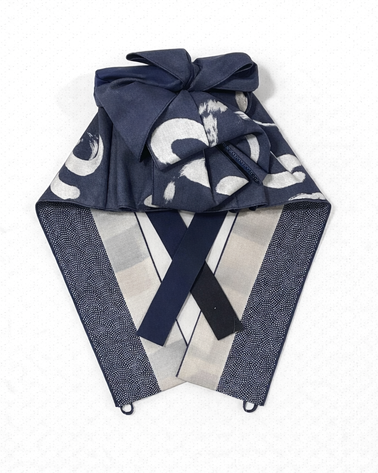
Pre-tied Obi 5011112001
Pre-tied Obi 5011112001
Couldn't load pickup availability
《Japanese Tradition enchanting on the back》
~ Tsukuri-Obi "Wanoha" ~
Specification: Reikousho Obi
"Characters: Ryujin (Dragon God), Fujin(Wind God) Ama-no-Gawa (Milky Way)"
Obi Body: Width approx. 17cm × Length approx. 440cm
Material:
【Obi】
Front: Deep Blue Cotton and Silk Twill (65% Cotton, 35% Silk), special fabric ink (lettering)
Back: Same (Shark-Scale Pattern) × Kasumi (Misty Gray) Tatami-beri (Tatami Edging Fabric) (100% Polyester)
【Tsukuri-Obi Fastening Components】 Triple elastic band, elastic, rayon cord
※Each piece is handmade individually, so please allow for slight variations in size.
【About Placing Your Order】
This product is a tsukuri-obi (pre-tied obi) made from an obi hand-lettered by the calligrapher Reikou.
※About Reikousho: A dynamic design of gold and silver ink characters, imbued with energy by the calligrapher Reikou.
※About "Wanoha": An easy-to-wear tsukuri-obi (pre-tied obi) (patent pending).
【About Shipping】
・Your order will arrive in approximately 2 weeks after payment confirmation.
・The kimono and accessories shown in the photo are not included. This listing is for the obi only.
※We do our best to keep stock information up to date, but due to system limitations, updates may sometimes be delayed.
※Unauthorized reproduction or editing of images from this product page is prohibited.


Product details - Pre-tied Obi [Wanoha] ~ Reikousho ~
- Pre-tied Obi "Wanoha" ~ Reikousho ~ -
【About "Wanoha"】
This is our original pre-tied obi (patent pending), tied with the image of wings soaring into the sky, created under the motto "beautiful even from behind."
※Please Note
・The decorative knot is secured with thread in several places to keep its shape, so please avoid pulling strongly on the "wings" (hane) of the knot.
・Removing all the securing threads will return it to a single obi.
・Strong friction or sweat may cause some fading or transfer of the gold and silver ink.
【Features of "Wanoha"】
・A gorgeous decorative knot made using a half-width obi
・A three-dimensional form with the look and feel of a hand-tied knot
・Easy for anyone to fit on by themselves
※The sides of the obi that come to the front of the body have tucks of 7cm and 8cm on the left and right, respectively.
Cutting the tuck threads allows the obi's length around the waist to be extended by up to 15cm.
(Please be careful to cut only the tuck's sewing thread, and nothing else.)
【About This Product (Obi)】
・This product is made using the traditional industry of Kojima, Kurashiki City.
・From material production to sewing, everything is Made in Japan — and specifically, Made in Okayama.
・Please note that the color of the product may appear differently in images than it does in person.
【Product (Obi) Features】
~ Cotton and Silk Twill ~
・A top-tier denim made by twisting three fine cotton threads together for the warp, and using silk thread for the weft.
・It combines the softness of silk with the durability of cotton, bringing out the best qualities of each.
・The fabric has an overall sheen, with a translucent, luminous color that is one of its key attractions.
・Dyes that resist fading are used.
~ Tatami-beri (Tatami Edging Fabric) ~
・Kojima, Kurashiki City accounts for approximately 80% of Japan's production — a traditional industry with a history of about 150 years.
・Being firm and lustrous, this material allows for full, rounded obi knots as well as elegant, refined knots that make the most of its sheen.
~ Reikousho ~
・This refers to the dynamic calligraphy applied to the Cotton and Silk Twill surface.
・The calligrapher Reikou writes the characters directly onto the obi using gold and silver ink.
・The characters written are auspicious ones, or the names of deities passed down in Japanese tradition.
・Every piece is one of a kind.

【A Message from the Shop Owner】
~ The Reason People Turn to Look Is in Your Back ~
Thank you very much for visiting the "KIMONO Terrasse" website.
For approximately 30 years, I have worked in fields related to kimono, including as a kitsuke (kimono dressing) instructor, a professional dresser, a kimono consultant, a wa-sou (traditional Japanese attire) advisor, and a wedding dressing assistant.
Through this experience, I came to one firm conviction: traditional Japanese dress is "beautiful even from behind."
The patterns depicted on kimono and obi are often described, especially overseas, as being "like paintings." At our company, however, we focus not on the patterns themselves, but on obi knots — creating knot designs specialized in expressing the ultimate beauty of form that a knot can reveal, along with the rich individuality of the person wearing it, and shaping them into something anyone can easily wear, which we share through our kitsuke classes.
It is said that, in the past, new obi knots were devised by kabuki actors and geisha, spreading among the general public and becoming trends of their time.
Even the "Otaiko musubi" (drum knot), now the most popular obi knot, is said to have originated in the late Edo period (1817), when Fukagawa geisha devised a knot resembling the shape of the taiko-bashi (drum bridge) being rebuilt at Kameido Tenjin Shrine.
It is also said to trace back even earlier, to a knot developed from the "Rokou musubi," devised by the second-generation onnagata kabuki actor Segawa Kikunojo (1741–1773), named after his haiku pen name.
I believe that obi knots are the embodiment of the creativity and ingenuity that people of each era have poured into living a little more richly — a spirit of enjoying life, given form.
Today, overseas, particular attention is drawn to the "back view" of a person wearing kimono, above all else.
When I walk through streets abroad in kimono, I am often met with words of admiration, or asked to have my photo taken.
Among these, I frequently hear people say, "Please let me photograph you from behind."
Thinking about this, it occurred to me that there may be no other traditional national dress whose back view is quite so beautiful.
Our ancestors entrusted the spirit of "living richly in heart" to the art of the obi knot and passed it down to us — and I believe that people around the world, seeing it today, are still able to feel that same spirit.
Just as knots such as the "Otaiko musubi" and "Bunko musubi" have been passed down across the ages, perhaps each of us living today could become a fashion leader in our own right, giving form to a modern "spirit of living richly in heart" through the art of the obi knot, and pass it on to future generations.
The pre-tied obi "Wanoha" is one such expression of that idea.
The Wanoha knot is created with the image of wings soaring into the sky.
The word hane (wings/feathers) often carries forward-moving images — of freedom, of leaping ahead, of independence.
May your life, too, be bright, forward-looking, and rich in spirit.
Why not walk with confidence in traditional dress that embodies that spirit — dress that makes everyone turn to look?
That, perhaps, is the truest form of a life that is "beautiful even from behind."